|
| |
 |
|
|
|
|
|
|
|
|
|
|
|
|
|
|
|
|
|
|
|
|
|
 |
|
|
|
Cusco – La Paz – Cochabamba – Sucre; 10-6-2005
Where did we finish our last entry…… uh…yes:
From Cusco we took a good and paved road over the Altiplano straight to Puno on the Lake
Titicaca. The most important thing that happened there is that Henno finally went to get his hair
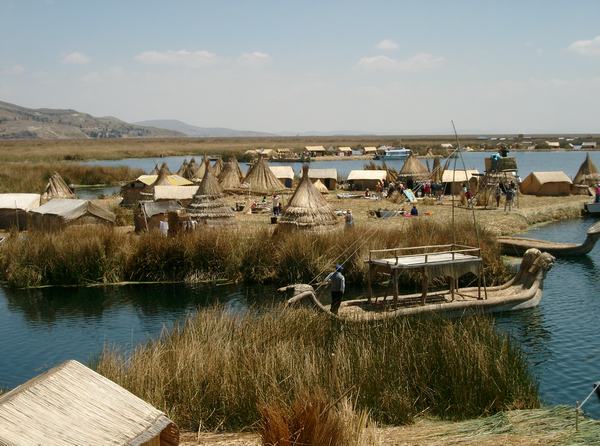
cut! ;-) (Like you will see on the pictures.) From Puno we visited the floating islands of the indigenous
Uro-people. Therefore at least one boat full of tourists stops at one of the
islands, which are all built out of reed, to let the tourists get off the
boat. On the islands they explained the tradition of the islands and their people and we could buy
souvenirs. On 4 sides the islands are connected to the ground of the lake so they don’t actually float around on the
lake. If there is an argument between two families who live on one
island, the one family “just” builds another island and moves it father away from the other
one. Houses, „ground“, boats, almost everything is made out of
reed, which also provides their food.
|
|
|
 |
|
|
|
Besides that the Uros eat much fish and ducks and go to the next town (Puno) to buy things like milk or so. They get their energy from little solar cells that were sponsored by the government. It was very interesting, but we always feel a bit uncomfortable when we enter such a different way of life and watch the people like we were in a zoo. On the other hand the people also get some money through the tourism.
Puno was the last town in Peru before we entered Bolivia on the 11th of September 2005. The border crossing was pretty
easy, like usual. We just always have to grin, when we get the men who work at the border out of their
lethargy. They come with a huge old-style typewriter and start copying the information of the bikes on the custom
papers. So far all the boarder crossings in South America were
free. But sometimes they try to tell us to pay some “Soles or “Bolivianos”
(or whatever currency they use) for a stamp or so. We always have to double-check our change because 90% don’t give the correct
change. Well, we probably don’t realize the other 10%?! But this is not just Bolivia but in whole Latin America!
In Bolivia we first visited the small town Copacabana at the Lake
Titicaca, where we were welcomed with some hours without power and
water. The wind had torn an electricity mast down. Copacabana is a quite touristy and – except the cathedral – not very pretty little
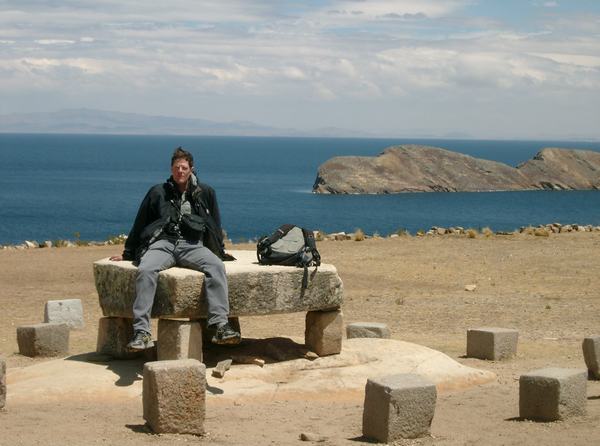
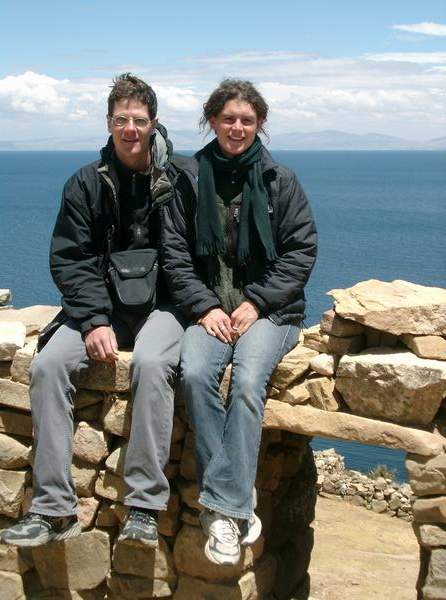
town. We had went there to do a day trip on the boat to the “Isla del Sol”. This “Sunisland” where are some ruins of the Incas was the sanctuary of the
Incas. It is said that this was the place where the Incas were created and their sun was
born. The lake lays 3850m high and the blue colour of the water and the view were
amazing! Although it was a bit chilly…
|
|
|
 |
|
|
|
Our next plan was to climb a 6000m high
mountain. We chose the Huayna Potosí north of La Paz, which is 6088m high. When we arrived in La Paz we had rain non-stop for 2-3 days
(which was – of course – not normal for this time of the
year). We didn’t want to climb the mountain in a snowstorm so we waited a couple of days and walked around the
city. The centre of La Paz is built in a valley and it grew uphill to all directions so it lies at an altitude between 3300m – 4000m. Although it is a big city it does not have a big western influence like other big cities in Latin America. Maybe because of its cool climate and the
altitude. There is a big indigenous population, people don’t buy in a grocery
store, but on one of the many markets with full stands that sell
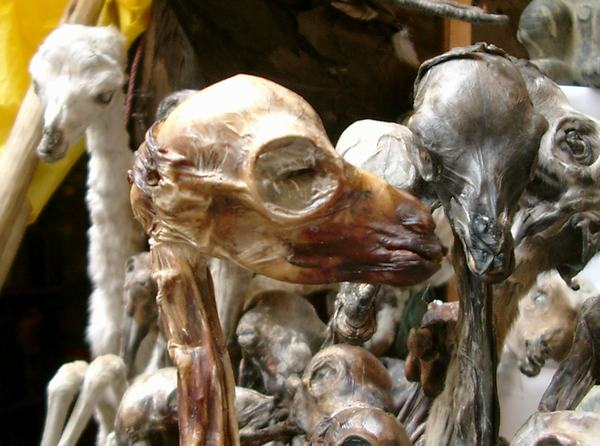
everything. It is always fun to walk around in the markets and see what kind of stuff they sell and just watch the people. Special was the “witches market”, where you can get ingredients of the traditional medicine and things for good luck like Lama
foetuses, blown up frogs with pearl eyes and other wired
things.
|
|
|
 |
|
|
|
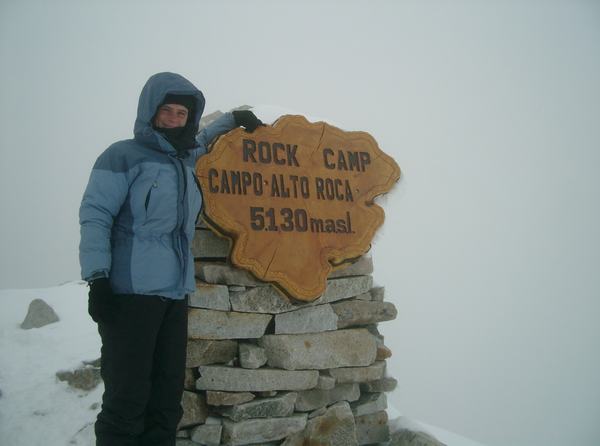
After 4 days the weather got better and we booked a tour to climb the mountain. At 10a.m. we left La Paz with our 2 guides who were our carriers and cooks as well to go to a refuge at 4700m. There we put our plastic shoes and crampons on and hiked to the “Campo Alto”, which is 5130m high where we spent the “night”.
|
|
|
 |
|
|
|
Normally there is no snow on the way to the “Campo Alto”, but we had snow from the refuge on. After a short and because of the cold and uncomfortably not very relaxing night our guides woke us up at 1 a.m. It had snowed heavily within the last 6 hours and we had to decide if we still wanted to climb the
mountain. Of course we wanted to! Us and 2 other groups climbed up through knee-deep fresh
snow. You cannot imagine how hard that was! Luckily it had stopped snowing so we had a nice view of La Paz and the surrounding
mountains. At an altitude of 5500m our stomach started to rebel a bit and especially I felt totally weak and
tired. The deep snow, the sleepless night, the thin air hit me with full power. I worked myself up to 5700m, before I had to go back with one of our
guides. On the way back I was able to enjoy a beautiful
sunrise. Henno went 200m higher to 5900m and climbed a 35m steep slope with a
pickaxe. Then he also turned back. To reach the summit would have taken 4 hours more under these
conditions. Our guides have told us from the start on that it wouldn’t be possible to get to the
summit. It was too dangerous and we could have missed some covered glacier because of all the fresh
snow. Once we reached the tent we fell asleep right away because we were so
exhausted. Usually it takes about 6-7 hours from the “Campo Alto” to reach the
top, it would have taken us almost the double time under those
circumstances. Though we didn’t get to the top it was a great
experience!
The next day we left La Paz and crossed the Altiplano with herds of Lamas and snow-covered mountains to
Cochabamba. There we met Emilia, a friend of my
parents, and her sister, Lourdes, who lives in
Cochabamba. We were warmly welcome there and it was really nice to have someone cook for
us! Although I must admit that cow tongue is not one of my favourite
dishes. Henno also tried several other local dishes like Guinea Pig or beef
guts. He said it wasn’t bad. Cochabamba lays at an altitude of 2558m but the climate is
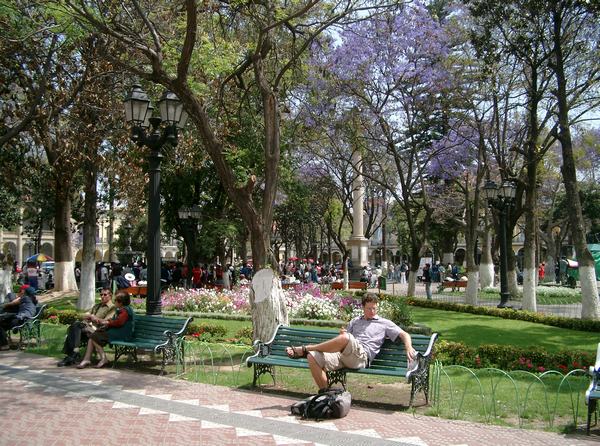
wonderful. During the day the temperature reached 25°-30° Celsius and the spring started on September 21st. So every morning we woke up with birds singing and we enjoyed the colours of the flowers and the trees even more since we did not have a spring this
year! After cold and grey La Paz we enjoyed Cochabamba with its quiet green
plazas, palm trees and parrots flying from tree to
tree.
|
|
|
 |
|
|
|
It was not easy to say goodbye to Lourdes. Thanks to Emilia, who took a big bag with souvenirs for us back to Germany we also have more space and less weight on the
bikes. So we left Cochabamba and went east to Santa Cruz, the last possibility for us to see the rain
forest. On the way there we got into some really heavy rain and were totally wet and freezing when we got to Villa
Tunari. The first time for weeks that we were at such a low altitude (290m) but we haven’t been that cold for a long time! We had expected tropical heat…In Villa Tunari is the wildlife refuge Inti Wara Yassi where animals from
hotels, circuses etc. who had to live under bad conditions got a chance to live in their natural
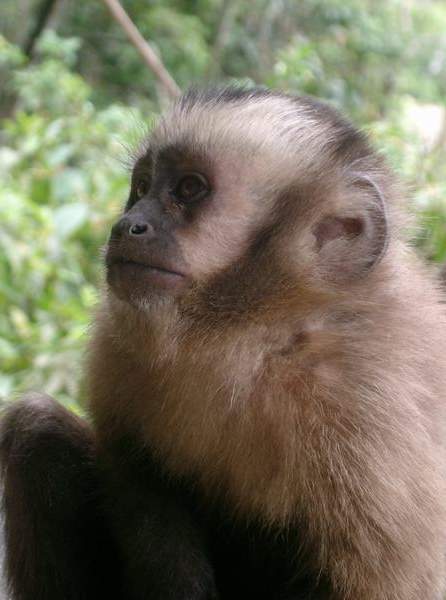
environment. There are about 400 monkeys, a Puma, a Jaguar, an Ocelot and a few
parrots. We liked the monkeys the best! Their human mimic and different characters are just
amazing!
|
|
|
 |
|
|
|
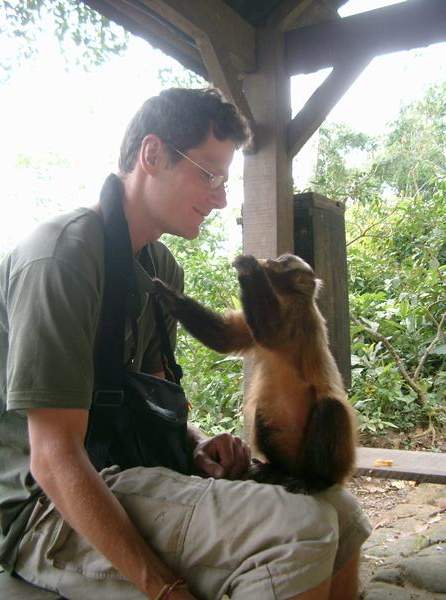
A new monkey had peed on my lap because he was so scared of the other monkeys. Another one unzipped and unbuttoned my pants many times with concentrated face. Henno got fed with bananas by a pregnant monkey girl and another one stole his glasses.
|
|
|
 |
|
|
|
And with no exception all of them checked all our pockets first to see if there was something eatable in them. We had a great time there and thought about staying for 2 weeks (which would have been the minimum time) to work as volunteers in the park. But we decided not to and finally we had to leave the animals because we were really hungry.
Close to Santa Cruz we could camp on the property of an Austrian
family. They have a farm with cattle and butchery so we got some fresh sausages
(great for Henno) and fresh baked bread. In the morning we got fresh milk, just from the
cow. Something you don’t really get often when you live in the
city!
There was not much left of the rain forest in this
region. They had cut down a lot to farm wheat, rice and sugarcane and the most part for grassland for the
cattle. Until you get to the border to Brazil and Paraguay the landscape is just Pampa and dead land… The people here don’t really know how to respect the nature, surely also because they have other problems
(e.g. just getting food to survive). For us it is quite shocking to see that they use rivers as garbage
deposit. They take their garbage bag, go to the next bridge and throw the bag into the water or dry
riverbed. But what else can they do when there is no one who picks it up?! On our trip we have seen so many times that people wash their clothes in the river and drive their car or bus into the water to wash them. We already feel bad when we throw the skin of a banana next to an empty oil carton in the nature…
After this short detour into the tropics we took a curvy road through pretty landscape up to about 1900m high where we spent 2 nights in the small town
Samaipata. Many Europeans have settled down there probably because of the comfortable Mediterranean
climate. Close to the town we visited a Pre-Inca fort and had a great view over the surrounding nature.Leaving Samaipata we took a rare-travelled dry mud road to Sucre. For this about 400km long stretch it took us 3
days. The road conditions were not the best and it always went up to about 3000m and down again to hot desert-like
scenery. It was fun but also quite tiring! On stop on this route was the small
village, La Higuera, which has a big history. In the previous school house of the village was Ernesto “Che” Guevara captured on the 8th of October 1967 and got shot one day
later. That was the time when he fought for equal rights for all people in South America. He had chosen Bolivia as base because it is in the middle of South America and shares borders with 5
countries. Today the school is a small museum. It was very interesting and it was emotionally very moving to be in the room where Che got
killed! You could think the village would be full of
tourists, but that was not the case at all! La Higuera has about 50 inhabitants who live in their houses built out of
mud. Electricity and phone connection did not find their way there
yet, which had surprised us after we found an Internet place in almost every little
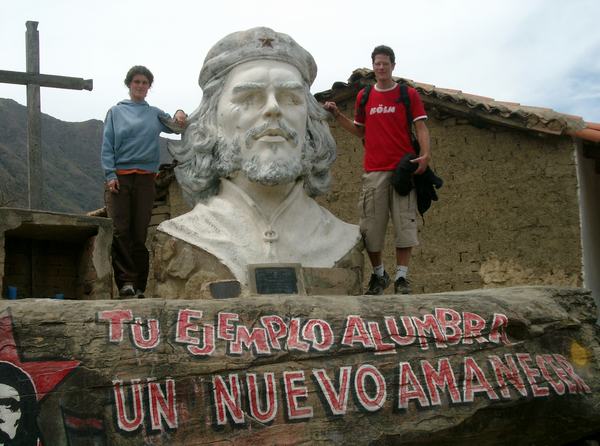
town! Right next to the tiny plaza was a huge statue of Che.
|
|
|
 |
|
|
|
Around this statue run some
dogs, donkeys and horses and grunting pigs lay in the
mud. Kids play soccer in the school area while some adults watch them and
chat. In the middle of them sits a partly paralysed girl in a pushcart – which is her
wheelchair. Everything was so simple and seemed so quiet and harmonic to
us! We decided to stay and just relax there for one day. It was pretty fascinating how silent a village without electricity can
be! No radio, no TV, no humming of some cables. Just the humming of insects and once in a while you could here a
cow, donkey or a pig. At night you go to bed while the frogs are croaking and in the morning you wake up by the
roosters. It was like being in another world, but we sure enjoyed the relaxing day. But I have to admit that I would probably go crazy if I had to stay there for more than 4
days!
2 days later we arrived Sucre (2790m), where we were welcomed with nice spring weather. Unfortunately this only lasted for 2 days before it got cloudy and rainy. Tomorrow we will leave Sucre and go to Potosi (4000m) where we want to visit a salt mine. From there we will go to the salt desert Uyuni, which has nightly temperatures of 20°C (0°F) below freezing point. After that we will have to leave Bolivia and keep going into Chile and Argentina. Bolivia is a great country and has a lot to offer! Some of the landscape is similar to the one in Peru, but less touristy and kind of more traditional. Bolivia is by far the cheapest country we have travelled through. There is yummy bread (almost like the one like in Germany) for 4US-Cent/piece, in the tropics we got about 25 of the mini-bananas for 12US-Cent and the gasoline costs 40US-Cent/Liter. Sometimes we wonder how the people get money out of these things?!
We are both doing
great. Slowly there are more and more things that wore down after using them so much (Digital
camera, water filter) and we have to take some of our clothes to the sewer in almost every big
city. But that is no surprise after 15months.The motorbikes also still seem to have fun travelling through America and we just made the 50.000km “full”.
Well, enough for now! We send a big hug and wish all of you a colourful fall (or a warm spring, depending on where you are)!
|
|
|
 |
|
|
|
Eure Henno und Alex
|
|
|
|
Potosí – Salar de Uyuni
(Bolivia) – Calama (Chile) – Salta – Mendoza (Argentina); 11-4-2005
After our last journal in Sucre we went to
Potosí, which lays at an altitude of 4070m. Potosí was once the biggest and because of the “Cerro Rico”
(Rich Hill), a hill that contains a lot of silver also the wealthiest town of Latin America. Although Potosí is pretty high and mainly a mining town it still has some pretty colonial buildings and there is a lot going on. We went there to visit the silver
mine. With a group of 4 people and our guide we first went to the place where they separate minerals like lead and silver from the
dirt. They use very poisonous chemicals to be able to separate the
minerals. Afterwards the dirt including the chemicals goes into the
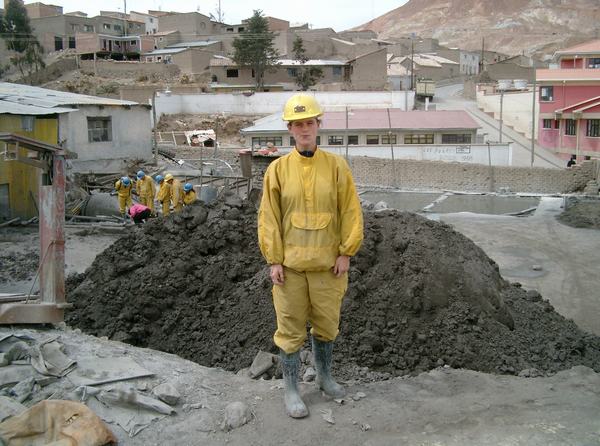
rivers. After that we went with our rented rubber
boots, a helmet and a head light into a tunnel of the
mine.
|
|
|
 |
|
|
|
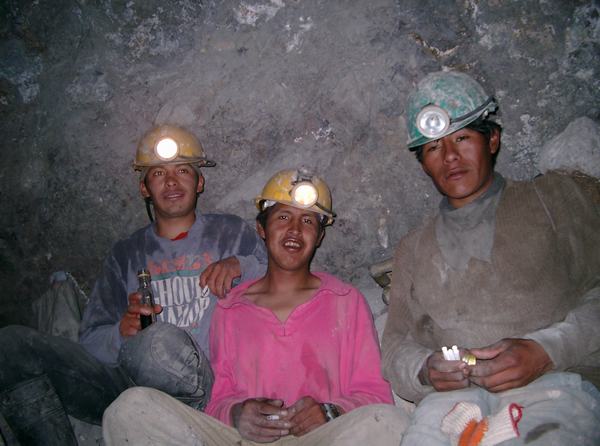
The deeper we went into the mountain the hotter (up to 40°C/102°F), dustier and less ventilated it got. The ceiling was sometimes pretty high so even Henno could walk upright in them, sometimes they were just 80cm (2.5 feet) high. Sometimes we walked through mud that went up to our ankles and it was quite slippery, sometimes the air was so dry that we had to sneeze and cough all the time and it hurt taking a deep breath. Which was necessary quite often at an altitude of 4400m. Pressed oxygen is led into the mountain by some pipes so the workers have air to breathe. Since we were 2-3 km inside the mountain it was also very dark. Under these circumstances the miners push and pull wagons that weigh 1-2 tons, make new tunnels by explosions and work under hard conditions 8 hours a day 5-7 days a week for a daily salary of about $4-6 US. Watching the people work, again felt like being in a zoo. But we were asked by our guide to bring something for the miners like juice, Coca leaves or cigarettes.
|
|
|
 |
|
|
|
So the workers also have at least some profit of the
tourism. Coca-leaves are chewed (actually you lay them inside your mouth in the
cheeks) or drunk as tea a lot especially in Bolivia. Coca helps against altitude sickness and increases the working ability because it enhances the capacity of oxygen
consumption. It is easy to guess that working in the mine is not very good for the
health. 40-50 out of 240 workers die every year; that would be almost one miner a week… We were glad to get out of the narrow mine after just 2
hours.
Riding another gravely washboard road over the beautiful endlessly seeming
Altiplano, it took us 8 hours for the 200km from Potosí to Uyuni (3650m). Uyuni has not much to offer except many travel agencies who arrange tours to the Salar de
Uyuni, the world’s largest salt flat. From other travellers we have heard about scary nightly temperatures of down to –20°C (-4°F) in the Salar. So we had bought a warm Lama blanket to survive the night in the
tent. After riding through the Pampa with herds of Lamas we entered the Salar 20km north of Uyuni and it was just
awesome!! It wasn’t possible to keep going without sunglasses because the mountain sun was reflected by the white of the
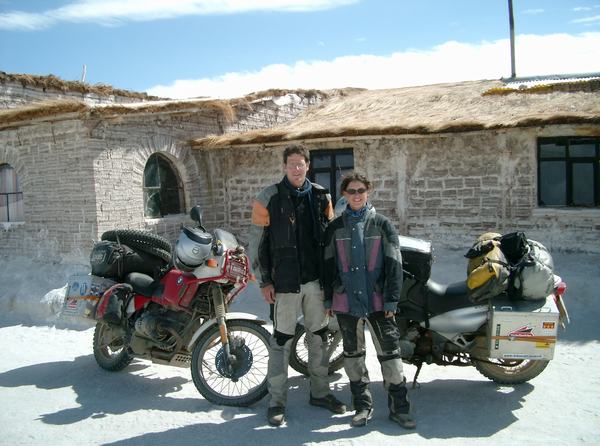
salt. At first we went to see the Hotel “Playa Blanca”, where everything is made out of
salt.
|
|
|
 |
|
|
|
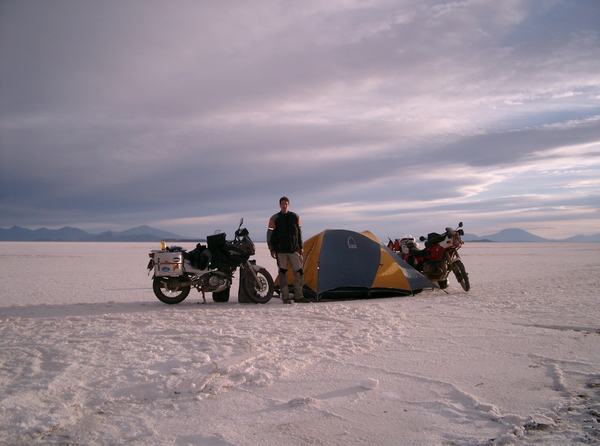
Crazy! Afterwards we rode farther out for about 100km on the Salar. You have to imagine a huge white flat area with hard ground. Depending on in what direction you look you see mountains or volcanoes, which partly surround the Salar or just the horizon. Awesome!! We really had to talk into ourselves that the white ground is neither cold nor wet when you sit on it. And also when you drive across it it is neither slippery nor icy. It just reminded us so much of a big flat of ice or snow.
Because of the endlessly white neither the eyes nor the lens of the camera have a fixing point and you cannot estimate distances so you can take funny pictures (see Gallery). In the middle of the Salar there are some Islands with cacti and even some animals that live there. On one of these islands they built a hotel what is kind of macabre. We pitched our tent up next to this island to spend the night there
|
|
|
 |
|
|
|
It was super silent during the night and we didn’t hear anything but the wind. With our new blanket it was pretty cosy in our tent! But the temperatures didn’t go below –5°C (30°F), still comfortable camping temperatures. It was quite easy to find the track to the island and out of the Salar without GPS because the many Jeeps who make tours leave clear paths we could follow.
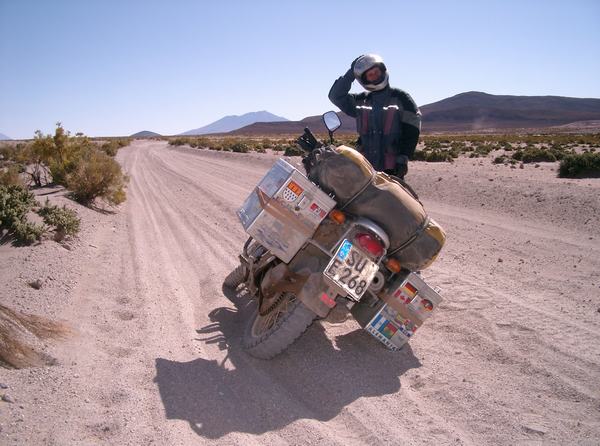
The road after the Salar was probably the most exhausting we’ve had so far! It was some washboard so deep that our bikes touched the ground with the engine cover, and sand. Just one of those is no fun with a motorbike, but both together really sucked! Once in a while it was less washboardy and more sandy what is hardly to handle with our heavy bikes and I put my bike gently on the ground.
|
|
|
 |
|
|
|
On that day we needed about 7 hours for 110km ... any
questions?? That’s why we didn’t get to the next village that would have been the border crossing to Chile. Instead we looked for a less windy place
(which is pretty hard in the desert) to pitch up our
tent. We finally found a ruin of a house where it was even lonelier than in the Salar! That’s where my stomach started rebelling and I had to get up in the middle of the night to empty it – under a beautiful night
sky. The next day I had to throw up several times and could not even keep a sip of
water. Luckily it was only about 80km on a gravel road through the desert to the next
village. After some breaks that my stomach wanted, we finally reached the border crossing between Bolivia and Chile. Like always without problems we crossed the border to Chile on the 11th of October 2005. But instead of signing the papers the first thing I did was vomiting on the custom house… In the little border village Ollagüe we took our first hotel room in Chile and were shocked by the high
price! It was 4 times as expensive as in Bolivia! But I was just really exhausted and slept for 14 hours
straight. The next day I didn’t feel much better, but I wanted to get to a bigger town where there’s at least electricity 24 hours and maybe a
pharmacy. But to get there it was still 200km and 7 hours of tiring
driving. The way went through a landscape with many
(active) volcanoes, brown stone-desert, different coloured lagoons with pink
flamingos, Vicuñas and no other persons at all. Henno loved it a lot but I could not really enjoy it and had enough to do keeping myself on the
bike. In Calama, a town in the middle of the desert, we found the first gas station after about 500km and we spent 4 days there to get well
again.
The first impression of Chile was that it was really quite
expensive! Gas costs about US 1.20 $/Liter and also everything else costs
more. We didn’t see any indigenous people with their colourful dresses and everything appears quite European. There are no more pretty colourful markets with their food stands
(like in Bolivia and Peru). No more women who have their babies tied onto their body and breastfeed them while they are stirring in a huge pot of
soup. Instead there is a huge mall with food corner with famous food
chains. There is a small market where you can eat, but there are no indigenous women who try to get us to their food stand. Instead there is a woman wearing jeans to take the order and you can pay with credit
card. Nice, but still unusual for us is that cars stop for pedestrians and nobody starts honking the horn when you did not take off right before the traffic light switches to
green. Well, if Chile and Argentina just are like that we will sure miss the “traditional” things we liked so much about Peru and
Bolivia!
Well, after 4 day in Calama I still didn’t feel very well, but we decided to keep going in little steps what had seemed to help
finally. It was also easier because the roads where perfectly
paved! So we went to San Pedro de Atacama next where we already got our exist stamp to leave Chile and enter
Argentina. On the way to the border of Argentina we crossed the border to Bolivia for a quick visit to see some white and green
lagoons, pink Flamingos and Vicuñas, which was very
pretty. But after about 30km of Bolivian gravel, sand and washboard road we were glad to get back on the well-paved road in Chile. After going over a 4800m pass and having some snow next to the road and icy wind we entered Argentina on the 17th of October 2005. The border crossing was very relaxed and after they were done with our papers they continued playing
Ping-Pong... We tried to get a few hundred meters lower to get out of the real cold wind! We drove through Pampa, salt flats and deserted nature before we finally found a place for our tent in the small canyon of a dry
riverbed. It was still one of the coldest nights we had with temperatures of a bit below freezing point inside the
tent. But after a clear night with a gigantic full moon the sun made everything warm in the
morning.
The next kilometres descended from the Altiplano on very curvy roads through a canyon with multicoloured stone layers and many cacti, through a dry forest (finally some trees!!) to Salta, our first city in Argentina. Salta has some pretty colonial buildings a very nice Plaza and a very European shopping street. It does have a market where you can buy fresh food like fruit and meat and also a food corner, which offers mainly Pizza. There are many Italian ice cream places (good thing my stomach was well again!!) as well and the Spanish has some Italian sound. It is hard not to see the strong influence of the European, especially Italian immigrants.
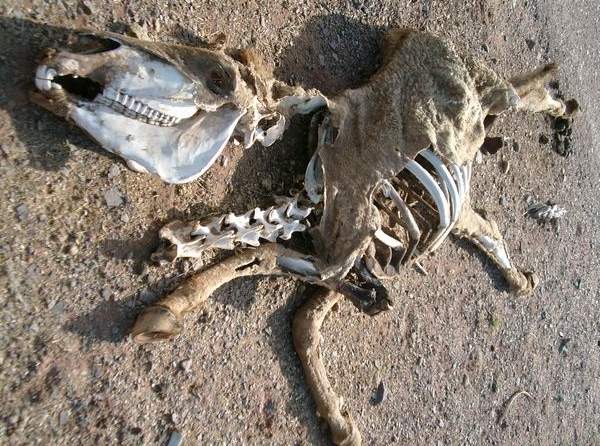
South of Salta we drove through beautiful, but not very green, dry and rather monotonous nature with Salars, Pampa and desert. The herds of Lamas got less and there were huge herds of Angus-cows, horses and donkeys instead. Unfortunately we also saw many of them just hit by a truck or already as skeletons next to the road.
|
|
|
 |
|
|
|
The one night we had spent in a village in an
oasis, where they make wine and we also tasted some Argentinean
wine. After that we continued driving through this
monotonous, lonely landscape. For some Kilometers we went through a wet cloud forest where everything was nice fresh and
green! Very pretty after weeks of being in the
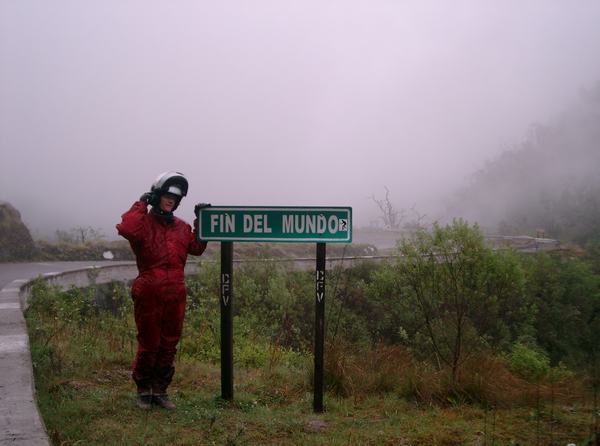
desert! Somewhere there was a sign next to the road saying “End of the world”. We have now idea why that was
there?!
|
|
|
 |
|
|
|
On the next few hundred Kilometres it was again
dry, brown and quite a strong and pretty uncomfortable wind had started to pick up. Travelling seemed to be a lot like in North America
again. Hundreds of Kilometres just straight and well paved roads through beautiful but hardly changing nature without seeing a
soul. There are good campgrounds with picnic tables and we have been invited to a good “asado”
(barbequed meat), which had made Henno very happy since he got my portion as well
(the word “Steak” doesn’t exist here).
We still want to take some time before we go all the way south to
Ushuaia, because it is still pretty chilly down
there! So we don’t take the direct way but take some little detours
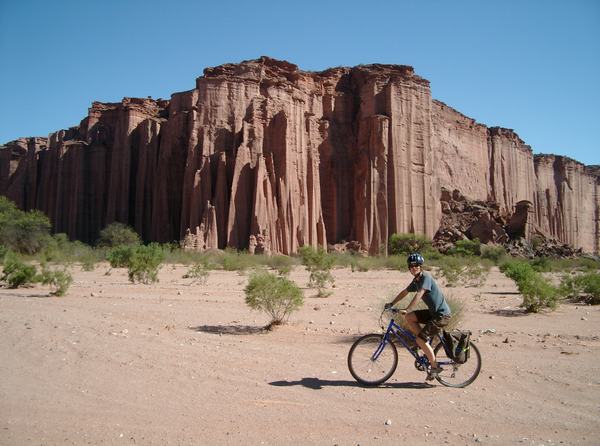
instead. For example we went to the Talampaya National Park. This is a canyon in the desert with walls up to 150m high. We have camped next to the Visitor Centre and the night security guy had showed us how to make a good
Milanesa, some kind of Argentinean Schnitzel.
|
|
|
 |
|
|
|
During the day we went on a bike tour through the impressive canyon.
|
|
|
 |
|
|
|
From the Talampaya Park we went westwards and camped the next night in the garden of a fancy hotel with natural hot
springs. One day later we visited a observatory close to
Barreal, which was very interesting!. We went south in the far west of Argentina parallel to the Andes and had the snow-covered peaks to the right and to the left a mountain chain with different coloured layers of
stone. It was awesome – although we also had quite a cool and strong wind from the left as well.
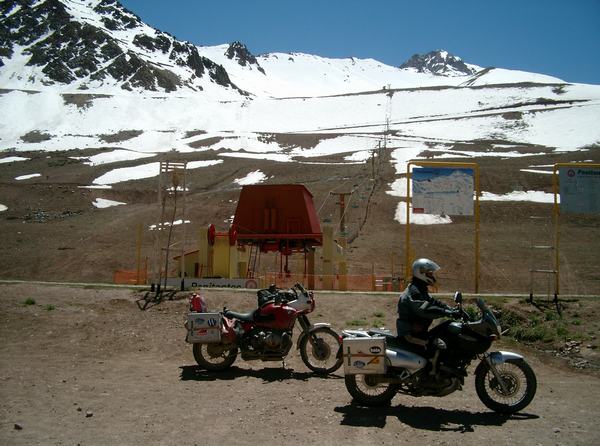
After 150 lonely Kilometres we stayed in a little Ski village
(the ski lift and slopes in 2300m were only 60km
away) north of Mendoza. After spending some pretty cold nights in our tent we thought we deserved something special and rented a cosy little
cabin; with own kitchen! Something we haven’t had for more than a
year! From there we went on a day trip towards the border of Chile, again through beautiful nature.
|
|
|
 |
|
|
|
Unfortunately the ski season ended in September so we had no reason to stay in our cabin any longer and 2 days later we left and went the short trip to Mendoza.
Since Mendoza will be the last bigger town on our way south we bought a new back tire for the Suzuki that we will carry with us for the next
Kilometres. We also took my Suzuki to the mechanic where she got some things done
(new chain kit, adjusting the valves, wheel bearing…). We just enjoyed walking through the nice city with huge trees and very nice houses
everywhere. The weather was great and we could sit outside at 10 p.m. just with a T-Shirt and have yummy ice cream. There is also a beautiful huge park where we could go running and just relax and feel like being back in the
civilisation. Mendoza (and the surrounding area) is THE wine region of Argentina and of course we visited one of the wine
bodegas, Chandon. There they make more Champagne, but the tour was very interesting and good
tasting! We like Argentina and especially the nature is
stunning! So we don’t miss the indigenous culture too
much. We sure enjoy having other advantages instead like good
campgrounds, mostly well paved roads, showers with hot
water, a higher hygienic standard…. So we can already get used to things like they are in Germany.
The cost in Argentina is also
ok: 1 Liter of normal gasoline cost about $0.60 US, 1 Liter beer for about $0.70 US and meat and wine for which Argentina is famous for is pretty cheap as well. There are many “big”
(over 250ccm) motorcycles here and sometimes we cant get our hand back on the handle bar because we are greeting so many passing
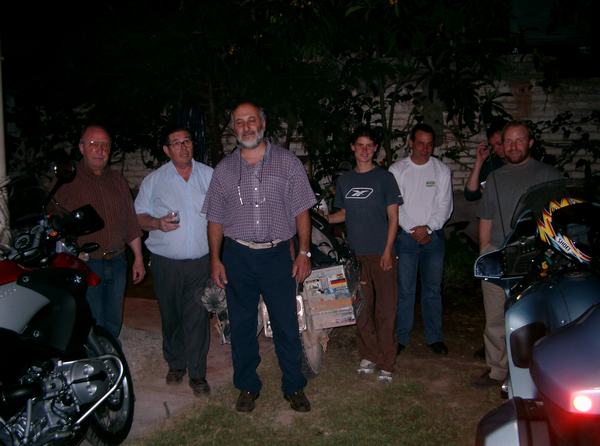
bikers. When we entered Mendoza we had met a motorcyclists who had invited us to the weekly motorcycle meeting with
Asado.
|
|
|
|
 |
|
|
|
In Bolivia the people thought motorbikes with more than 250ccm just don’t
exist. It is quite amazing how different these 2 neighbouring countries
are!
The Argentineans love to have their Siesta and from about noon until 4p.m. everything is closed and very
tranquil. Most people enjoy their Mate tea at this time. No matter what age, almost everybody carries a thermos with hot water and Mate herbs with them so they can have their Mate anytime they
want. Unusual for us is that many restaurants don’t open before 9p.m. because that is the time the Argentineans eat
dinner. The main dish here is meat. Salad or other vegetables normally don’t come with the
meal.
Well, that was enough news for now. We hope the pictures in the Photogallery give away a bit what it really looks like!
We have a bit more than 2 months and approximately 8000km
left. Partly through Chile, but mainly in Argentina. it is a weird feeling that we really have to plan our next days to be able to see everything we want to
see. But you’ll read about that later!
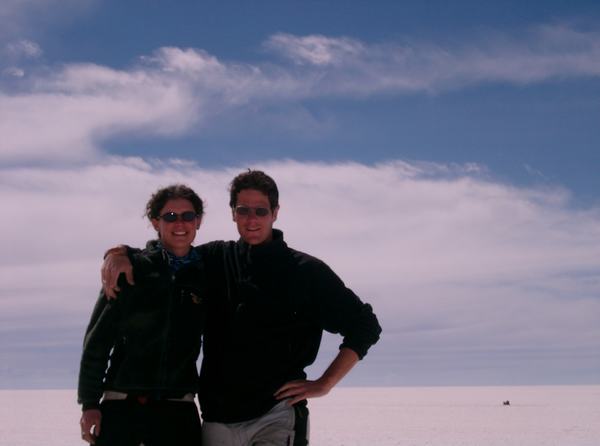
Hopefully you can enjoy a nice fall with few rain and wind while we enjoy the spring?!
Big hug from Mendoza to wherever you read this!
|
|
|
 |
|
|
|
Alex and Henno
|
|
|
|
Mendoza
(Argentina) – Pucón (Chile) – Bariloche (AR) – Chiloé – Carretera Austral (CH) – Ruta 40 (AR) – Punta Arenas (CH); 12-11-2005
After we have spent almost our whole last day in Mendoza with finishing the last entry
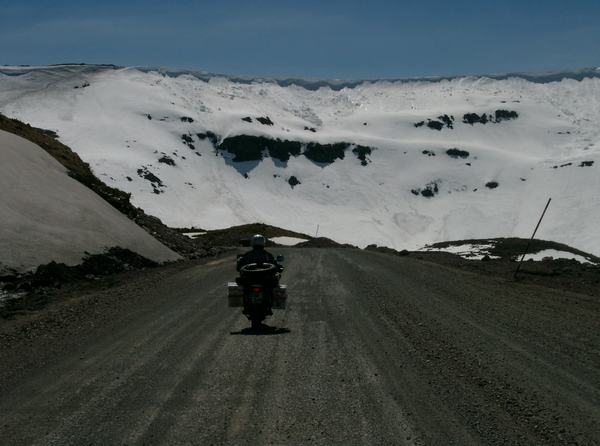
(we hope you appreciate it!), we left the pretty town and had a few days of just driving on straight roads through boring Pampa. Welcome in the endlessly seeming Patagonia… Some Km we went on the legendary “Ruta 40”, which was partly new
paved, partly a slippery gravel road. Over the Pass Pino Hachado we crossed the border again and went to Chile on the 6th of November 2005. Right before we got to the border the scenery changed and instead of Pampa there were nice snow covered
mountains, turquoise coloured lakes and creeks and Araukarias some very interesting needle trees that only grow in northern Patagonia as far as we
know. On the highest point of the pass we went through high snow walls toward the Chilean
custom.
|
|
|
 |
|
|
|
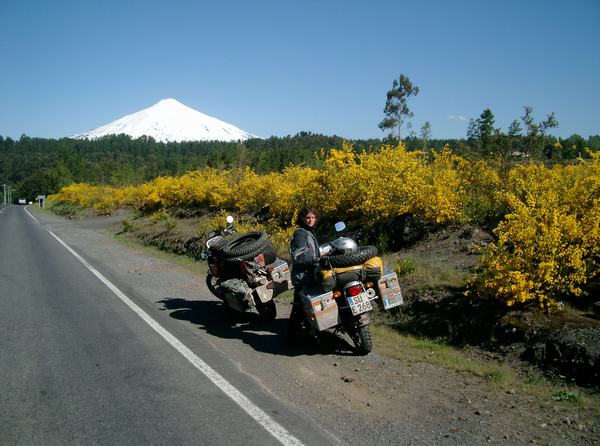
Because Chile is free of the Mouth-and-foot-desease you are not allowed to enter the country with fresh food. We knew that, but we still had some groceries with us. One custom officer wanted us to open a box (unfortunately it was the kitchen) and started looking for forbidden things. He found a Salami and Henno had to eat it right away or throw it away. Luckily he was happy with what he found and didn’t keep searching so we didn’t have to eat all our fruits, tomatoes, cheese and milk. On the Chilean side of the pass the landscape changed quite a bit again and everything was fresh and green and we went through thick forests along green farmland. If the snow covered tops didn’t belong to volcanoes we would have felt like being in Switzerland!
|
|
|
 |
|
|
|
We even spent the night on the property of a Swiss Hotel and did a nice hike through Bamboo and Araukaria forest. While we walked on the bottom of a snow-covered volcano through lava rocks we could see another beautiful snow topped volcano. After long days of driving it felt great moving our legs and walking around a bit!
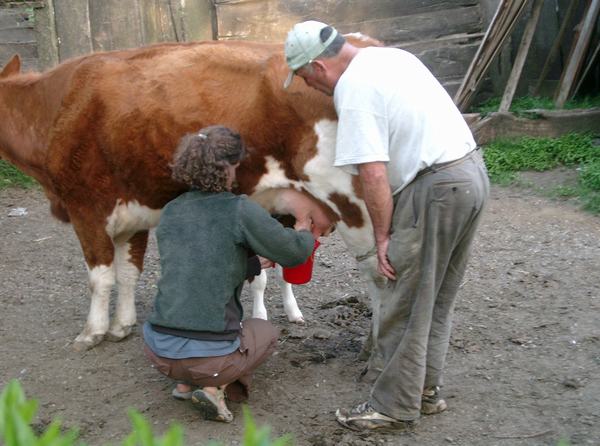
From there we went to the touristy region of Villarica/Pucon where we have camped on a farm with hostel of a Mapuche family (early inhabitants of Chile), where it was very relaxing with a nice atmosphere. So we stayed 2 days and spent some time with the other guests of the hostel. Also the farmer showed me how to milk cows which is a lot harder than it looks!!
|
|
|
 |
|
|
|
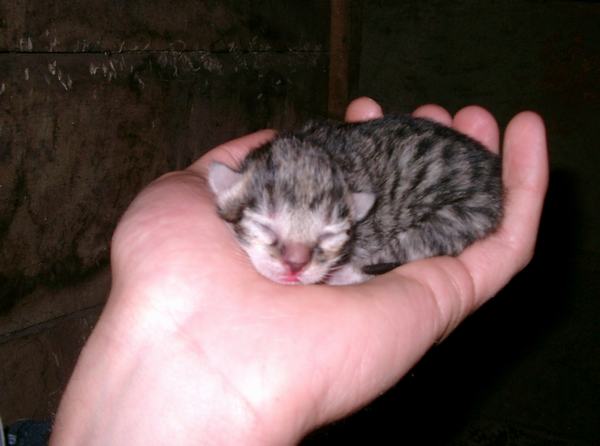
Because Henno and I also discovered a cat with her not even 1-day-old very cute kittens we had a hard time leaving this place.
|
|
|
 |
|
|
|
Like we said Chile is very
pretty, but for camping we pay as much as we pay for a nice hostel in Argentina
(about $14US for the 2 of us). So we didn’t stay much longer in Chile and took a ferry to cross the Lago Pirihueico to get to the Passo Hua
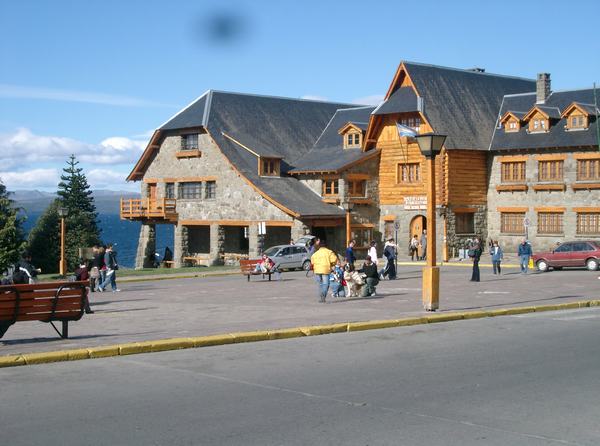
Hum, which is the lowest pass of the Andes between Chile and Argentina (660m). We entered Argentina on the 12th of November 2005 and went to the nice touristy town of San Martin de los Andes that looks like it is a little copy of
Switzerland. From farther above it was hard to see the town because it is set in the
forest. All the houses are partly made out of wood and Cafés and Hotels have German
names.
|
|
|
 |
|
|
|
It was nice to spend 1-2 days there before we had
enough. Afterwards we got to San Carlos de Bariloche, which is much more touristy and not as nice as San Martin. There we both got our front tires and the Suzuki the back tire
changed. So we didn’t have to carry the 3 tires with us any
more! In Bariloche we had to decide if we wanted to go to Chile again and see some more
volcanoes, lakes and the island Chiloé or if we just wanted to go south in
Argentina, which would be less exciting because of the Pampa, but much
cheaper. We also heard about never ending rain on Chiloé… That was so much easier in
Bolivia: there was only one way to get to a certain
place. Here we have too many options to choose from. That will be different in the south
again.
From Martin and Katja, another couple who is travelling with motorbikes we had heard that they were staying with Claudia and Klaus, a German couple, 100km south of Bariloche. Claudia and Klaus have been travelling with their motorcycles for 16 years! When we went there Katja and Martin (who we got to know in Panama) had just left, but we spent a nice evening with Claudia and Klaus and yummy self-made bread. The next day we finally decided to go to Chile and see Chiloé. Because it was already a bit late we spent another night in Argentina very close to the border to Chile where we met Terry and Jack, 2 motorcycle riders from the US who invited us for dinner. We had a great time and spent 6 hours together and we all could hardly stop talking about travelling experiences.
In Chile we first went to
Frutillar, which was founded by Germans. They had German cake and said the houses are typical like in Germany, but we didn’t really see
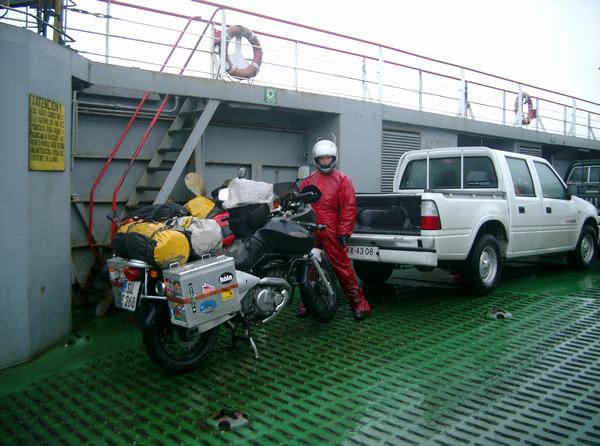
that. But it was a nice little place to visit. The next day when we took the ferry to Chiloé we got to know the non-stop rain we’ve heard
about.
|
|
|
 |
|
|
|
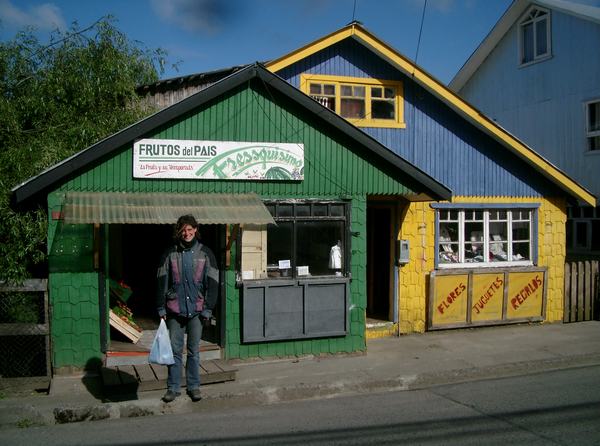
On Chiloé we went to Chonchi, a little town on the island and were totally soaked when we got there. We stayed 3 days and were finally lucky with the weather and did some day trips. We also enjoyed some very good (and cheap) fish that we cooked for dinner. Chiloé is nothing especially great, but we liked it. It is the poorest region of Chile and seemed to be a lot more traditional. Most houses are made out of wood and are painted in all different colours, which looks very cute.
|
|
|
 |
|
|
|
In the south of the island is a monument where officially the Pan-American Highway
ends. But we will still go down to Ushuaia! After 3 days on Chiloé we took the ferry to get to Chaitén on the mainland where the “Carretera Austral” goes
by. This road is known and notorious among the South America travellers for its bad condition and the
landscape. When we got the tickets for the ferry we met Mitchell, a 65-year old BMW rider who lives on
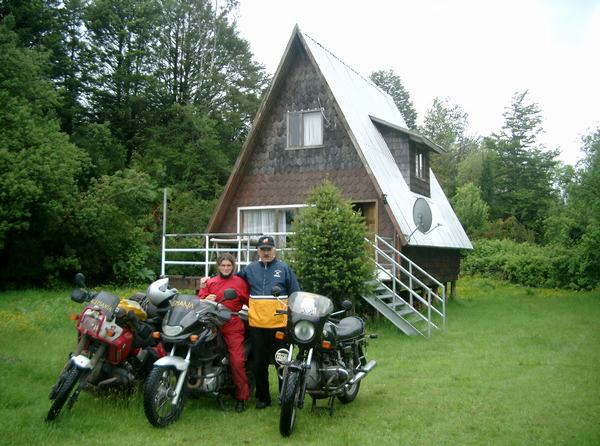
Chiloé. His 3rd sentence was that he had a Cabaña
(wooden hut) close to Chaitén where he wants to invite us to
stay. We just got to the Cabaña when it started pouring
rain, which didn’t stop for 2 days. Inside of the cosy Cabaña Mitchell served us yummy King
Prawns, fish, Octopus (all fresh), wine, etc. We also tried dark beer mixed with raw dove
eggs, which sounds a lot worse than it actually is! It was very nice although it was a bit tiring because Mitchell was bad hearing and didn’t like wearing his hearing
aid. He also didn’t care what our names were. Henno was simply called “GS” after his bike or “el Alemán”
(the German) and I was called “Freewind”. Mitchell was probably just glad to have people
around. Since he lives right next to the ticket shop we think that he just might go with the ferry when he sees that there are motorcycle travellers so he can invite
them?!
|
|
|
 |
|
|
|
But after 2 quite lazy days it was time to hit the road again! We were probably as glad as Mitchell that we finally left?!
Unfortunately all the waiting hasn’t helped because it just continued pouring
rain. Which was too bad since we were hardly able to see any of the beauty of the nature with its rainforest-like
vegetation, the hundreds of waterfalls and glaciers. But the bit that we saw was even nicer and a bit mystical because of the
rain. In the following night we luckily found a place under a roof to pitch up our tent with the view of a hanging glacier (well,
sometimes). But it is really no fun to put the cold and still wet clothes on in the
morning! So we kept going through the rain until we got – freezing and totally soaked – to
Coihaique, the only bigger city in the area. Although we wore a T-Shirt, a thick
fleece, “waterproof” jacket inlay, motorcycle jacket and the “waterproof” rain suit we were wet down to the
skin! Our hostal was not the best because it rained through the roof and didn’t have furnace so we had 8°C (45°F) in our room… But 2 days later all our stuff had dried over the wooden oven and we left with a partly sunny partly cloudy
sky. And finally we could enjoy the beautiful scenery around the Carretera Austral with its ups and downs and many curves passing green and blue
lakes, pretty mountains and no living sole. Would be perfect to pitch up the tent at any nice
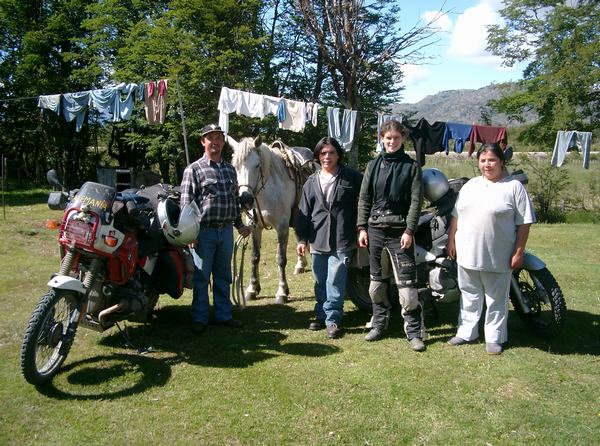
spot, but in Chile everything is private with a fence all along the road so it is not possible to camp wild. We asked at one of the few houses if it was possible to camp
there. Of course it was ok and the young farmers couple told us many times how nice it was for them to have
visitors.
|
|
|
 |
|
|
|
Before we could even take off our jackets they asked us to drink a Mate with
them, which is also very popular in southern Chile. Having Mate together is more a social thing than anything
else. For a Mate you fill the cup 2/3 with Mate herbs and add hot
water. You drink the Mate with a “bombilla”, a metal straw with a little sieve at the
bottom, so you don’t drink all the herbs. The cup is always refilled with water and the cup goes around so everybody can have a drink. It reminds a bit of the peace pipe of the Indians. But it is very
cosy! They also invited us to have dinner with them in their little
Cabaña, which had neither electricity nor water. They cook on their wooden
stove, light the Cabaña with a gas lamp, the radio works with battery and they get water from the creek
nearby.
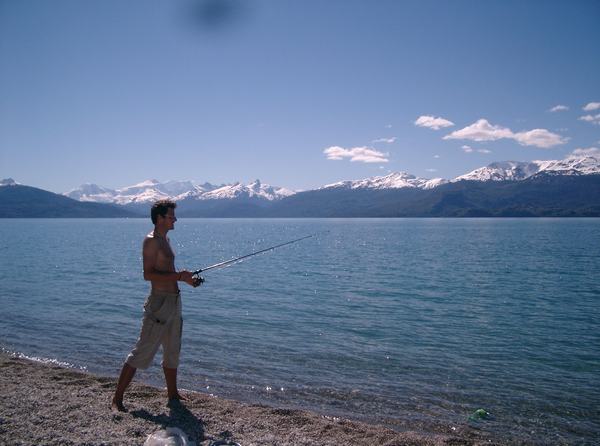
Our next day was rather short because we really found an open gate in the permanent fence and after a picnic lunch at Lago General Carrera we decided to pitch up our tent an the beach. After all the rain and the cold we just enjoyed the sun and went into the lake for a very quick bath. The water was too cold to go swimming. Henno tried to catch some fish but unfortunately was not successful but we had a nice and relaxing day!
|
|
|
 |
|
|
|
On the 1st of December 2005 we entered Argentina from Chile Chico and a day later we had the famous “Ruta 40” ahead of us. We had heard a lot about this part of the “Cuarenta” and were warned many
times. They said the road was pretty bad and went 600km through boring Pampa where the wind never
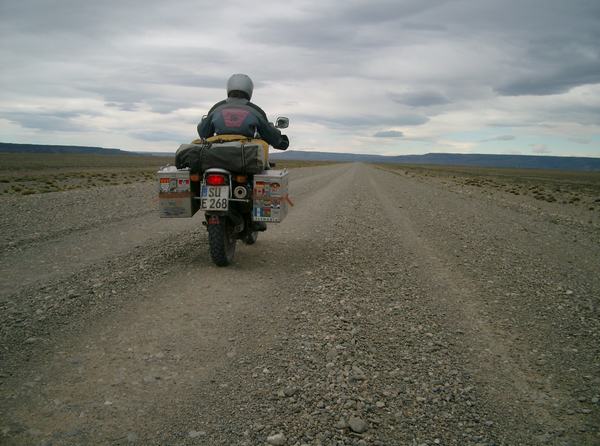
stops. But of course we still went! Altogether the condition of the road was
ok, although about 60km went through deeper gravel. In the middle was always deep
gravel, but if you stayed in the narrow tracks of the cars you had a hard
surface.
|
|
|
 |
|
|
|
It was just a bit tricky when – besides the strong wind that pushed us in a tilted angle – even stronger gusts tried to push us into the deep gravel and off the
road. We had no other chance than slowing down and get back on the road
again. We had to concentrate every second and it was very
tiring! Until the horizon you could see nothing else but Pampa grass in the slightly hilly
landscape. There are many herds of cattle, sheep and horses along the road and it seems like they didn’t belong to anyone because there are no stables or fences
anywhere. Here and there we saw impressive condors, guanacos
(type of lama), armadillos and ostriches, which can run up to 70kph through the Pampa. After the first day we asked at some lonely house
again, if we could tent out of the never stopping wind. That was no problem and we could even lay our mattresses on the floor of an empty room and were also invited for
dinner. The 2 workers who lived in the house were in charge of maintaining the Ruta 40. In those situations we think about how travellers are treated in Germany?!
After the 2nd day on the Cuarenta we almost made it to the end of the gravelled part (and the beginning of the
asphalt), but 30km before that we pitched up our tent next to a gas
station. After 6 hours of fighting against the wind and the rough road we were just too tired to keep
going. 25km behind the gas station the road was really newly paved and I was so
happy. After (almost) 1000km of difficult gravely stony roads I had just enough of
it! Although I have to admit that a paved road doesn’t fit in the picture of the “myth” of the Ruta 40 and
Patagonia! But the cold wind that comes from the west most of the time was still there… It is a strange feeling when you ride a left curve with 70kph and are still tilted to the right side because of the wind.
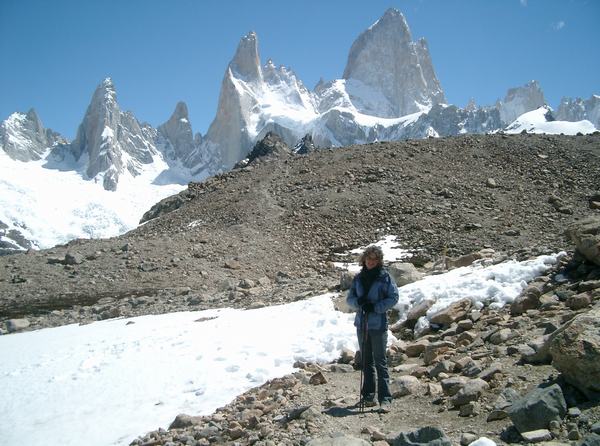
After being in the loneliness for a few days we went to the El Chaltén, which was full of tourists. The village is a Mecca for trekkers because of the Fitz Roy. When we got there it was freezing cold and even snowed a bit, but at the end we were very lucky with the weather and had 2 days of clear sight of the gigantic Fitz Roy Mountain.
|
|
|
 |
|
|
|
We went on two daytrips in that area and on the 2nd one we met a couple (Renate and Ingo) with a German Landrover with the license plate of the same city that I
have. And above that we also found out that my grandpa was Renate’s favorite teacher at primary
school. What a coincidence!
When we had seen enough of Fitz Roy we went to see the next
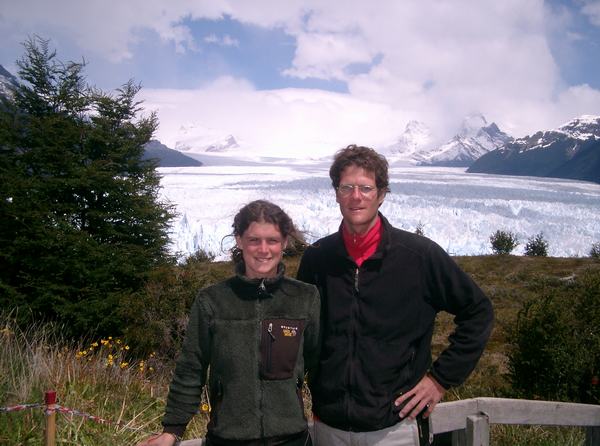
highlight, the Glacier Perito Moreno that goes into a
lake. It is not possible to realize the size of this ice
field. It is just huge! Only when a comparable miniature tourist boat went close to the glacier you could estimate HOW big it was. We just stood there and listened to the cracking and thundering sounds that came out of the glacier and the loud splash when an ice rock fell into the
lake. What a spectacle of the nature! At about 11a.m. busloads full of tourists
arrived. When they all started screaming “aaah” and “oooh” and clapping their hands every time an ice rock fell it was definitely time for us to leave the
place!
Since we didn’t get very far that day and the cold wind took all our energy we asked at a gas station in the middle of nowhere if we could camp
there. David, the guy who was on shift offered us to sleep on the floor of the little
building. We were very thankful for that because the wind was very strong that night and although the house didn’t have a furnace and we had 5°C (41°F) it was still better than in the
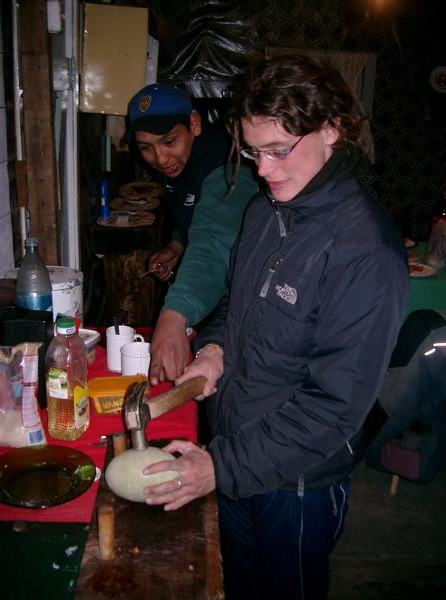
tent. We were also invited for dinner again: we had an ostrich egg! The egg is very big and had to boil 2
hours. To crack the hard shell we had to use a
hammer!
|
|
|
 |
|
|
|
It tasted almost like a chicken egg. The next day (12-9-2005) we crossed the border to Chile again and went to Punta
Arenas. You have to go through Chile again if you want to go to Tierra del
Fuego. Here we are at a degree of latitude of about 53° on the southern
hemisphere. The days are getting longer and it doesn’t get dark before 10.30p.m. It is interesting and still a bit strange that the sun is in the north in the middle of the day. Punta Arenas lies at the Strait of Magellan, which is a natural strait and divides the Island of Tierra del Fuego from the rest of the American
continent. Tierra del Fuego (Land of Fire) is called that way because in the history passing sailing explorers saw many fires on land. The early inhabitants had used these fires to keep themselves warm. On Tierra del
Fuego, which belongs partly to Argentina, partly to Chile is the southernmost city of the
world: Ushuaia (Argentina). We also want to go there because the southernmost road of America ends there as well. Besides that Ushuaia is THE meeting point for travelers at Christmas. We are not sure yet if we really want to join this mass
meeting. It is incredible how many travelers we have met within the last weeks who want to be “down” there for Christmas!
It is a very strange feeling to be almost “there” and done with our trip after 17
months! We have a bit more than 5 weeks before we will fly home from Buenos Aires (on the 19th of January 2006). Since we want to be there at least one week before that we basically only have 4 weeks of traveling
left. Wow…!
From Punta Arenas we will take a ferry to Tierra del Fuego and ride the last 400km to Ushuaia before we will head back up north to Buenos Aires on the Atlantic coast. Because there are more and more little things that start breaking down (especially the zippers of our tent) and screws start falling off the Suzuki because of the vibration of the bad roads it seems to be time to get back home again.
Besides our dry skin and chopped lips because of the cold wind we are doing great as
always. We will try to enjoy our last weeks in South America, which will be accompanied by the cold wind. Where we will spend Christmas and New Year’s Eve we don’t know
yet. We didn’t even get into a Christmas mood yet because they just start decorating the stores and everything a
bit. We wish you all a very merry Christmas and a happy new
year! Windy greeting from Patagonia from
|
|
|
 |
|
|
|
Alex and Henno
|
|
|
|
Tierra del Fuego – Patagonia – Buenos Aires; 1- 12- 2006
At
first: Feliz año nuevo! – Happy new year! And here our last journal from South America:
In Punta Arenas we finally met Katja and Martin, who are travelling with their motorbikes since Montreal for 20 months
now. We had met them in Panama and since then tried to meet them on the road
again. Glenn, a motorbike rider from Belgium was travelling with them for some
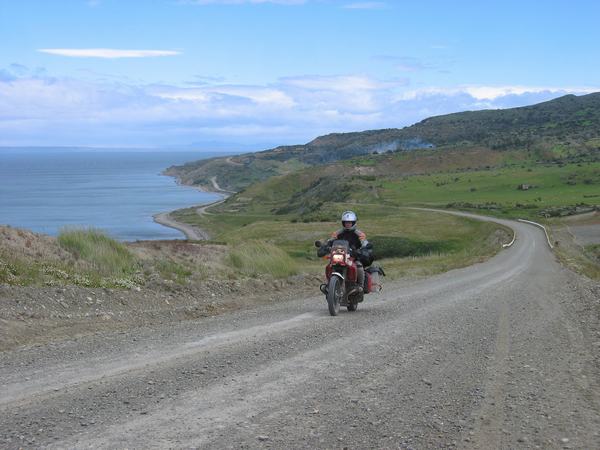
weeks. Together we talked until late at night until the sunrise at 4.30 a.m. After so many miles on the road is was nice to share some stories… On the 15th of December we took the ferry together to cross the Straight of Magellan and reached Tierra del Fuego (Land of
Fire). The first Kilometres went up and down on a curvy gravel road along the coast and green farmland with hundreds of
sheep. It was very pretty!
|
|
|
 |
|
|
|
After about 140km we crossed the border from Chile to Argentina and went to the not very interesting city of Rio Grande where we wanted to stay 1 night and go on to Ushuaia the next day. At the end we stayed 4 nights because we felt really comfortable at the “Club Nautico” with its owners Rita and Carlos. There was a
fitness/work-out room, which was not used any more where we put our mattresses and slept on the
floor. It felt a bit like being on a school trip! There was also another
motorcyclist, Normen, from Germany who just got to Argentina after he crossed Africa with his
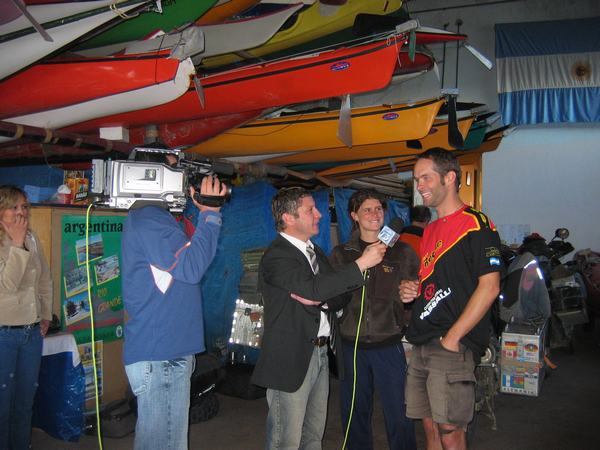
bike. The first morning in Rio Grande the local TV came to interview us (in
Spanish!!), which was broadcasted the same afternoon.
|
|
|
 |
|
|
|
Every Friday night the Club Nautico is having an
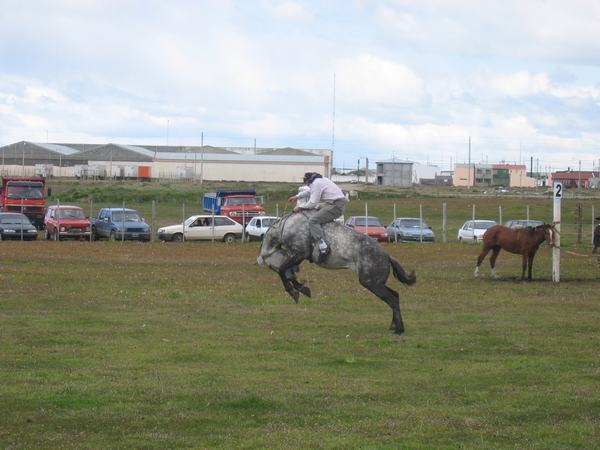
Asado, a Barbecue, where they put everything they have on the “Parilla”, the grill. We had a great time and also met Jorge who invited us to go horseback riding the next day and one day later we went to a Rodeo with
him. Although we didn’t really like how they treated the horses it was an interesting
experience.
|
|
|
 |
|
|
|
Since we didn’t leave Rio Grande very early after the 4th night
there, we still didn’t make the 220km to Ushuaia because we took a detour through pretty landscape off the paved
road. It was like we didn’t really want to get to the last place of our
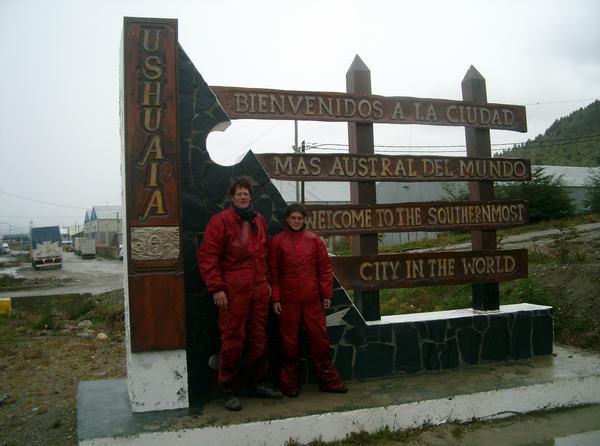
trip?! But on the 20th of December we finally made it to
Ushuaia, the southernmost city of the world. Well, it was not very hard to get there because the road was paved almost all the way down
there.
|
|
|
 |
|
|
|
We were very disappointed from the city
itself. It was more than full of tourists who got almost stuck in the shopping street and it was very
expensive. On the campsite were vehicles with German, Swiss, English, etc. licence plates and it was the first time for long that we were in a traffic
jam! That was really not what we had expected of the end of the
world! At first we were so disillusioned that we almost turned around right
away, but at the end we stayed 3 nights. One night we spent in the National Park “Tierra del Fuego”, where is also the official sign of the “Fin del Mundo”, the End of the World, which also means the end of the southernmost streets in America. The park is very pretty and definitely rather like “one” would expect the end of the world to
be. Dead tree trunks in a green, orange and red marsh
landscape, many small rivers and different coloured
lagoons. Unfortunately we didn’t have a view of the open ocean at the end of the world because there are many little islands in front. But because of the misty air and the grey sky everything looked kind of
mystic. It was a weird feeling to be there after so many months and Kilometres of
travelling, but it was not that spectacular any more. Maybe itwas just too easy to get to the end of the
world?! Since we are also looking forward to get beck home we were not depressed or something like we had heard from other
travellers.
The next night we stayed on an official campground where all the motorcycle travellers meet for Christmas. It was nice to exchange some
experiences, but when some people can’t talk about anything else than how many Km they did with what tire and which profile and who needed how much time for so many Kilometres it really gets a bit
boring! We also didn’t share the opinion of being so happy to be away from “awful” Germany and never going back
there. So Henno and I escaped after 1 night and went back to Rio Grande to Rita and Carlos where we liked it a lot and were welcomed like good old
friends. Katja, Martin and Glenn came one day later and we all celebrated Christmas
there. We were 9 people for Christmas Eve and at about 11 p.m. – it is normal to have dinner quite late in Argentina – we started
eating, and there was so much to eat!! At midnight we took our glasses and wished everyone a merry Christmas and even got some presents from our
hosts! From the leftovers of the dinner we still ate 2 days later so we had a reason to stay until the 27th and not only until the 25th like we had “planned”… The 1st day after Christmas we went on a day trip with Rita and Carlos to the wrack of a boat and an old light tower and the 2nd day we just did some little things that needed to be done like burning
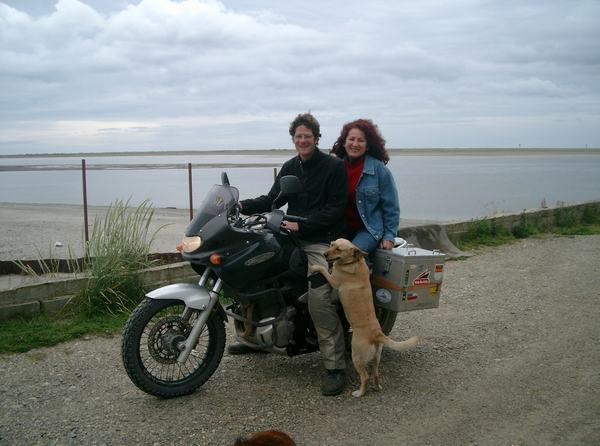
fotos, fixing some small things on the bike, etc…. After all it was hard to say good-bye to our friends Rita, Carlos – and of course dog Dina!
|
|
|
 |
|
|
|
To get from the Argentinean part of Tierra del Fuego to the Argentinean main land you have to go through Chile
again. So we had to cross 2 borders that day (Dec., 27th 2005) – our last border crossings of the
trip. It was all a bit annoying and took some time because December is the high travelling season in
Argentina. Once we got onto the mainland we took the paved Ruta 3 that goes right to Buenos Aires. It goes mostly straight through boring Steppe and Pampa. But it is still quite tiring because of the steady wind that comes from the west most of the time. Especially when trucks come from the other side it is pretty tough because the wind gusts almost pushed us off the road when we pass them. In Rio Gallegos we said Bye to Katja, Martin and Glen because they wanted to go another way.
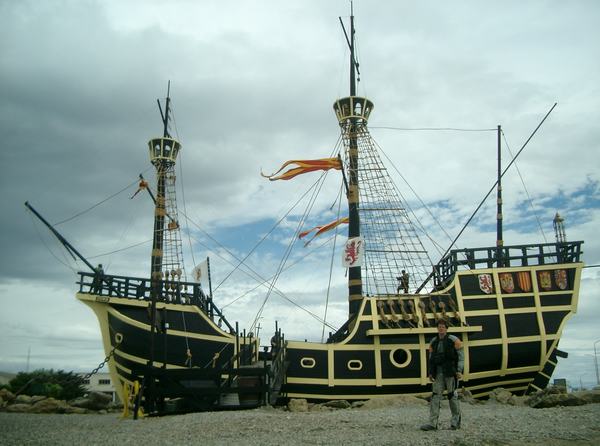
To make the boring Ruta 3 more interesting we stopped at a little port in San Julián where we visited a remake of an old sailboat Magellan had sailed with, very neat!
|
|
|
 |
|
|
|
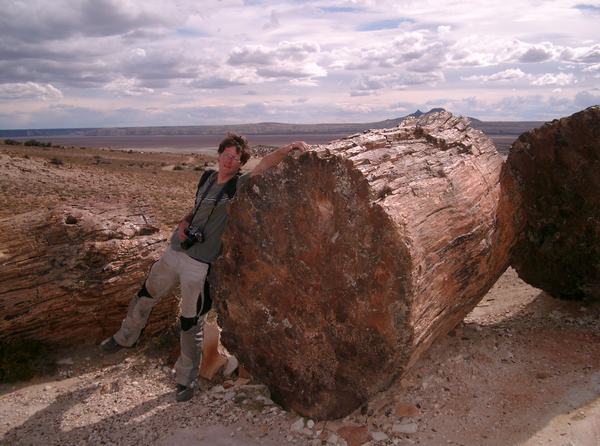
We also went to visit a petrified forest, which was very interesting as well.
|
|
|
 |
|
|
|
After we left there we had the longest day trip of our
trip: 600km in one day mostly on the straight paved Ruta 3, always going
north, facing the sun. We had a lot time to think and all the sudden it hit us that we only had a few days of our trip
left. Thinking of that did make us feel a bit sad…
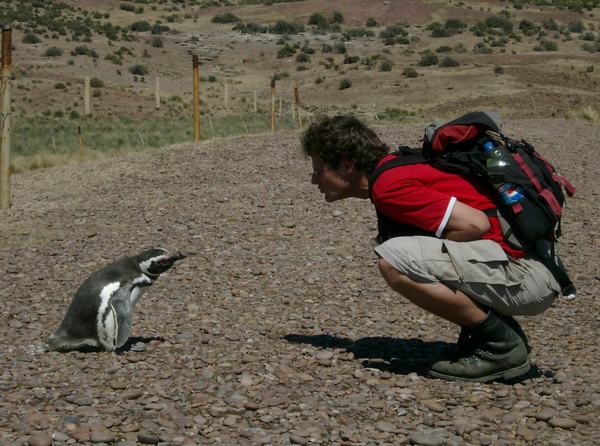
Our next stop was the Penguin colony in the Natural Reserve Cabo Dos Bahias, where there is hardly any tourist because there is no Tour bus or public transportation to get there. It was very nice and with only 3 other people we were in between hundreds (thousands?) of Penguins and had to laugh about their funny way of walking (I am talking about the animals, not the tourists!). They are really cute!
|
|
|
|
 |
|
|
|
Since it had rained quite hard a couple days before we got there it was not possible to take the
mud/gravel road along the coast so we had to get back on the boring 3 north to Puerto
Madryn. Through the motorcycle forum we got an invitation from a motorcycle rider in Puerto
Madryn, where we arrived in the evening of the 31st of
December. With Miguel, his girl friend Georgina, his family and another German motorcycle
traveller, Olaf, we had a nice quiet New Year’s Eve. The New Year began with rain and ugly 15°C (60°F), which was – of course – very unusual for this time of the
year. Normally in January it is sunny and 30°-35°C
(around 90°F) …
After 3 days in Puerto Madryn we went back on the boring “3” heading north
again. To have a change of the never-ending Steppe we took an alternative route from San Antonio de Oeste along the
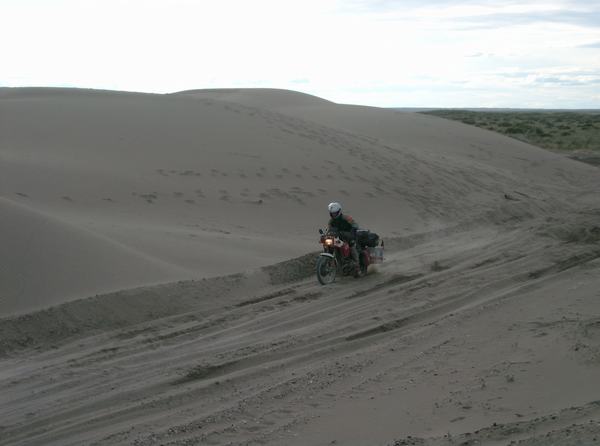
coast. The landscape was not a whole lot different, but instead of good pavement we went on a very sandy dirt road with a lot of washboard and a wandering dune in our way.
|
|
|
 |
|
|
|
Not the best alternative to the 3… But we found a nice place on the beach where we put up our tent –the last time with no other people around us. After we managed to get the bikes out of the sand back on the road the next morning we kept going more or less along the
coast. Our last day in Patagonia was very typical: strong wind, a bit of rain and dark
clouds. Also the fauna showed almost everything it
got: ostriches, foxes, armadillos, roadrunners and – to our surprise – thousands of
yellow, red and blue parrots. They flew so disorientated that we had to watch out that we didn’t hit
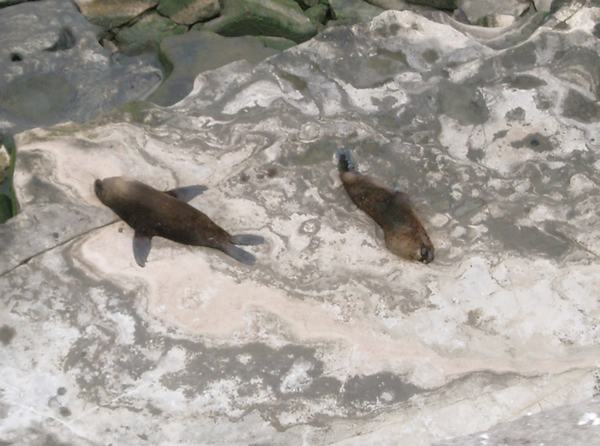
one! When we went to see some seals (or were they sea
lions??) where we saw tons of parrots again, we found out that there is the biggest parrot colony of the
world. The birds have their nests in the walls of the steep coast and were a lot more interesting than the sea lions that just lay there fat and
lazy. What a live!
|
|
|
 |
|
|
|
In
Viedma, a not very interesting town, we only wanted to stay for one
night, but because the weather was so nice we decided to stay another day and spend some time in the sun on the beach of the Rio Negro. Our first day of beach and swimming since we took the sailboat from Panama to
Colombia! Of course we got light sunburn…
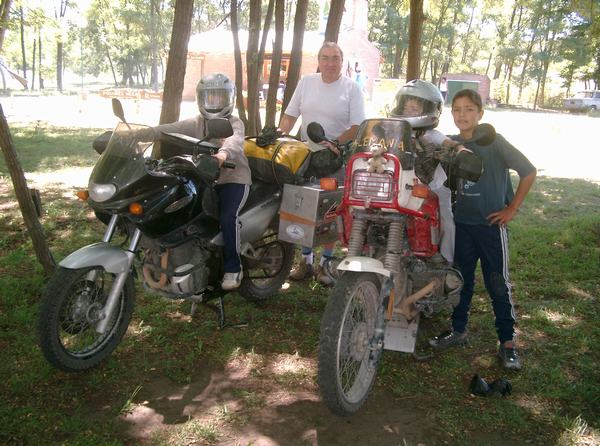
The next detour to get away from the 3 was into the little mountain chain Sierra de la
Ventana, where we pitched up our tent outside a little town on a picnic
place. It was very nice to be in the mountains instead of the boring endless Steppe! We wanted to stay only one
night, but when we went to say Good-Bye to our camping
neighbours, the 3 sons convinced Henno to play Soccer with them for quite a while that we decided to pitch up our tent again – only 50meters from where we had put it the night
before.
|
|
|
 |
|
|
|
We still had some time left to get to Buenos Aires anyways und it was only 550km
more. Our last night before we got to the capital was in the little town of Las Flores where it was almost unbearably hot and we sat in an ice cream place at night to watch the people. The atmosphere there had reminded us a lot of a southern European
city. But the heat got worse and worse and the sky darker and darker… When we went to bed in our tent a heavy storm started and a loud thunder was right above us and it began to rain like
heck. After a while the storm calmed down and the thunder faded
away, but it kept raining. The 2nd, 3rd and 4th thunderstorm went over the place and it was still
raining. The water level underneath the tent went up and after a while it felt like laying on a
waterbed. When Henno moved on his side, I was moved by the little waves of the
water. Slowly the water came through the floor part of the tent and on our inflatable mattresses we were reminded of the floating islands on Lake Titicaca (and it was still
raining). After a while the mattresses were soaked as well and everything that didn’t hang on the one line in the tent was totally
wet. The clothes that we were wearing, the sleeping
bags, our hair, everything was so wet – and it was still
raining. Also our motorcycle gear that was in the (not any more
waterproof) bags underneath the vestibule of our tent was
soaked. Maybe you can imagine that the night was not very
relaxing. The first sight out of the tent when it was light out was not the best: our tent was in the middle of an about 25cm (12inches) the whole place covering “puddle”. The dream of every camper fulfilled in our last night in the
tent. Maybe we should also mention that – of course – it was the first rain after a dry period after more than 4 months without one
raindrop... After we had fished our boots out of the water we just packed everything together like it was, put something dry on
(which did not include the motorcycle gear) and went the last 200km to Buenos Aires. Good thing it was not that hot any more because Henno’s back tire was pretty worn down to the mash and the heat would not have been good for the rest of the
tire.
We entered Buenos Aires through the ugly and poor suburbs with a grey and rainy sky and got close to the chaotic
downtown. It was pretty tiring because it seemed like there are no driving rules at all – or we just didn’t get
them?! At which red light do we have to stop and at which ones can we keep going without slowing down?? Do we have to ride very offensive like everyone else to get any
farther?? Although we were so tired because we hadn’t slept the night before we got to the motorcycle shop in the part Florida
healthy. It is a shop that is known among the motorcycle travellers and there are also beds in the shop where we stayed for a couple of
nights. We did some little things on the bikes (changing of oil and Henno’s back tire…) and it was kind of raining non-stop so we didn’t waste time by being inside all the time.
Well, arriving at Buenos Aires means that we are at the end of a wonderful trip with many many great and hardly any bad
experiences. After travelling for 18 months, through 16
countries, about 65.000km and meeting so many great people without any big trouble we are going back home to Germany. The minor problems we did have – without them it might have been boring – we will put in the box saying “experiences” … ;-) Our bikes worked hard and never let us down. Although the BMW was a bit weak on Tierra del Fuego for a few Kilometres and the Suzuki throws more and more screws off
herself. On the last dirt road she wanted to get rid of the back tire
protection, which we had to put on the back of the BMW after it was wrapped around the back
tire. But altogether we are very happy with our bikes and would always take them with us
again! Wherever…?! Henno will leave his bike in Buenos Aires and come back in the summer to use his 6 weeks of vacation he will have being a
teacher. The Suzuki will fly to Frankfurt on the 18th of January where we can hopefully pick her up 2 days
later.
We have about 1 week left here in Buenos Aires and will use the time to seea bit of the city – hopefully without
rain. We will fly home to Germany on the 19th of
January. We are happy to get back home and see our families and
friends, but we are also a bit sad that our great trip is
over.
We will have a last journal about our last days when we are back
home. Until then have a great winter or summer – depending on where you are and take
care!
Rainy greetings from Buenos Aires from
|
|
|
 |
|
|
|
Alex and Henno
PS: Unfortunately our digital camera does not work any more so we don’t have too many pictures this time...
|
|
|
Buenos Aires – Niederkassel
(home); 2-20-2006
It’s about 5 weeks now since we got back home from our
journey, but we have to admit that it seems to be like at least 5
months! As soon as we got back there were many things to do so there was no time to be “homesick” for
travelling. But now we want to tell you about our last couple of days of our
journey:
At our 3rd day in Buenos Aires our friends Katja and Martin, the other German couple with
motorbikes, also arrived at the garage where we stayed at and we spent 2 nights
together. Because everyone had some things that needed to get taken care of within the last
days, we couldn’t spend too much time together. But we had a very nice farewell dinner in a typical Argentinean restaurant – with salad buffet for the
vegetarians.
After we had spent 4
(or 5?) annoying nights in the dormitory in the
garage/work shop, we were very happy when our friend Maurizio who we’ve met in Medellin;
Colombia, offered us to stay in a new and still empty apartment in the north of Buenos Aires. The apartment was in a small condominium with a nice little swimming pool in the middle of the garden which we could use on our very last day.
Maurizio has helped us a lot with different things and showed us some interesting parts of the city – which was very helpful in a town with more than 16 million people. Henno could even leave his motorcycle in the garage of Maurizio’s
brother.
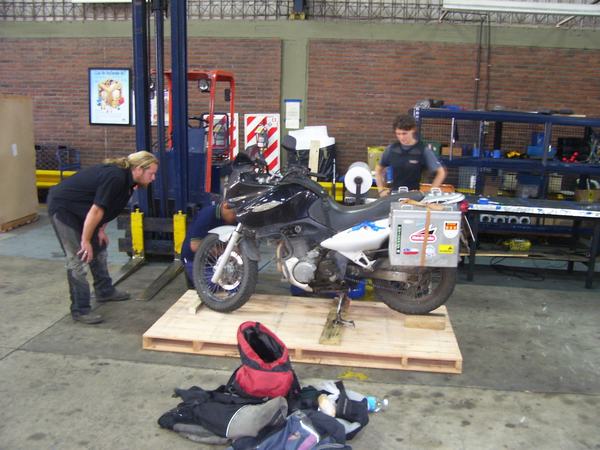
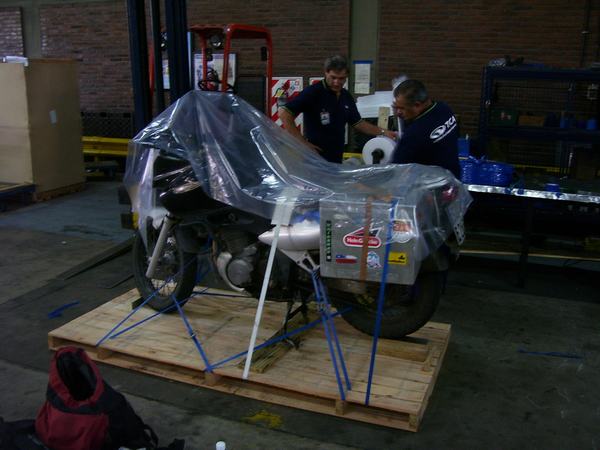
On the 16th of January we took the Suzuki with full side boxes and mixed feelings (will she get home safely??) to the airport in Buenos Aires. We pushed the bike as it was (in one piece, with the boxes attached) on a palette and the airport crew helped us tow the bike onto the palette. The only thing we had to do was unhook the battery before we left my bike by itself.
|
|
|
 |
|
 |
|
|
|
The bike flew to Frankfurt, Germany, on the 18th of January so it was ready for us to pick up on the 20th. It was a very weird feeling leaving the bike there knowing that we would
(hopefully) see it again in Germany! We had sent the bike with Lufthansa, which cost us altogether about 800,-€ and although we had some doubts at first we were very content how everything worked out!
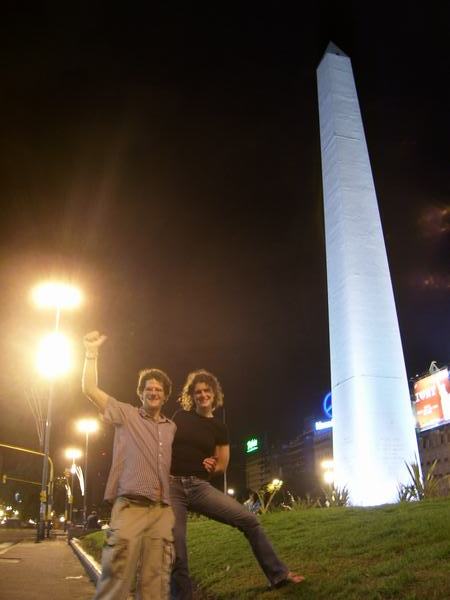
When the Suzuki was gone we had some time to get to know the city a bit night and day – with and without Maurizio.
|
|
|
 |
|
|
|
We have not really seen a whole lot mainly because it was almost raining non-stop with thunderstorms, humid and about 30°C (85°F). So we used the time to go shopping for clothes (especially Henno) and little presents for our friends and family in Germany. Lucky Henno we also went to many Argentinean Steakhouses but after a while even Henno did not want to eat any more meat. It is really incredible how much meat they serve in these restaurants every night!
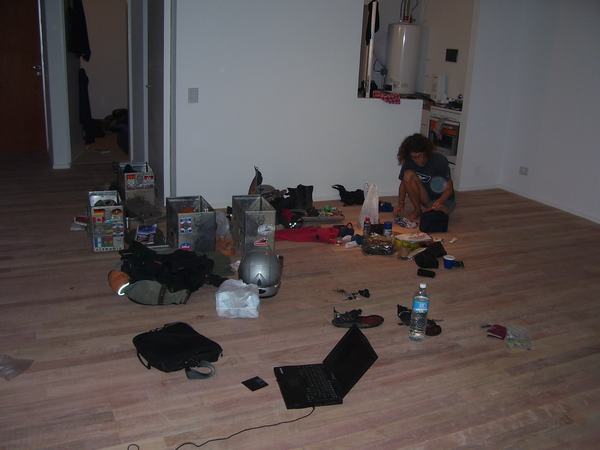
Besides shopping and eating we tried to get the chaos in our “empty” apartment a bit
organized. Some things we wanted to leave in Buenos Aires with Henno’s
bike, most of the things we wanted to take home with us. We’d got quite some stuff together within the last months on the road and we were wondering where we had put all these things while we were
travelling?!
|
|
|
 |
|
|
|
On our last day in the capital we finally had great weather and spent the time with reading and sunbathing at the pool and packing. We thought that we had really deserved that!
On the 19th of January 2006 we took a taxi to the airport – very tired and very excited at the same time. We flew from Buenos Aires to Sao Paolo where we had 5 hours to wait for the connecting flight and from there it took 12 long hours to get to Frankfurt. In Frankfurt we were surrounded by 10 fire-fighter trucks as soon as we
landed, because the pilot got the warning signal that one of the turbines of the plane was on
fire. As if everything wasn’t exciting enough
already! But luckily it was a false alarm and after we got out of the airplane we were the first ones who got the luggage out and as fast as we could we went to the cargo section of the airport to see if the Suzuki was already waiting for us. She really was. Everything went amazingly simple and fast: we handed out our freight
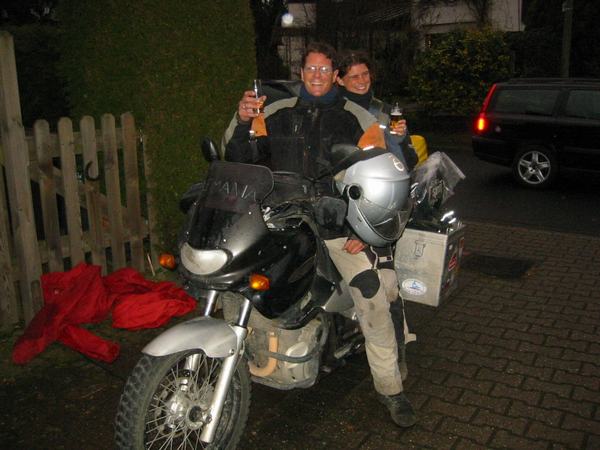
papers, the custom stamped everything that we needed and totally tired and excited we received the bike in a perfect condition. We tore all the straps and coverage down, put our motorcycle gear on and climbed on the totally overloaded
bike. The Suzuki started right away like she couldn’t wait to get back
home!
Although it was pretty cold and misty, at the end we could fulfil our dream and instead of finishing our trip at the airport and get picked up we could ride our own bike home.
|
|
|
 |
|
|
|
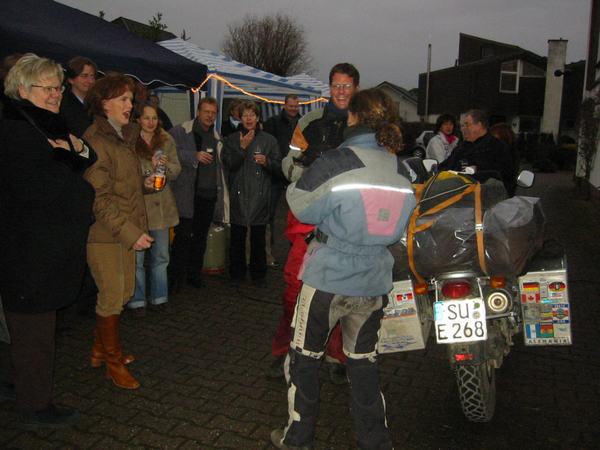
As soon as we reached my parents house in Niederkassel close to Köln (Cologne/Colonia) the „welcome committee“ gave us a Kölsch
(beer brewed in Köln) and many many friends hugged us and congratulated us to our healthy homecoming – it was super
nice!!
|
|
|
 |
|
|
|
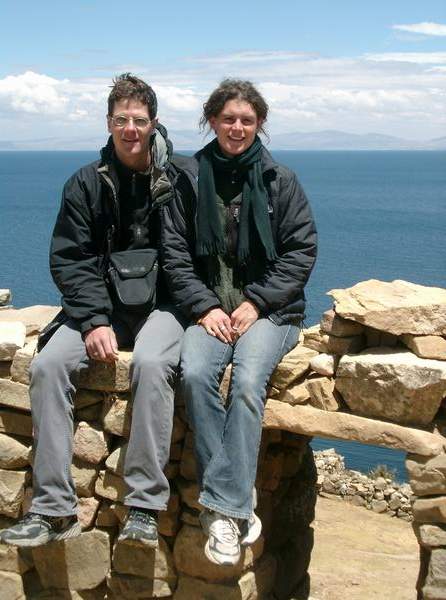
With our safe return to Germany ended a wonderful journey for
us, without any major problems and with great memories … and writing this down makes me a bit
melancholy. Within the 18 months of travelling for about 65.000km in all countries between Alaska and Tierra del Fuego we only made good
experiences. We got to know many different people; some of them are good friends for us now and thanks to them we made these great experiences in their country and even
farther. We also learned on our trip that it is important to just accept help and friendliness without having to give anything in return – which rather would have been insulting in some
situations! But we really hope that we will see many of our friends again and be able to show them around where we live!
Many people here back home keep asking us where of all parts we have been to we liked the best. A question which is hardly possible to answer with one
word! We don’t want to miss any part of our trip, that’s for
sure. For the nature we liked the best Alaska, the wide west of the USA, parts of
Mexico, the volcanoes in Central America, the Andes in South America, the deserts in Bolivia and Chile the width of Argentina just to name some of it. Amazingly nice were the people in Colombia –
but, like we said: we met great people everywhere! Cultural interesting were
Mexico, Guatemala, the South of Colombia, Peru and
Bolivia.
If we would do the same trip again? Yes, but after seeing what we saw and making the experiences we made we would sure do some things differently. any more questions we will only answer in person (or e-mail). ;-)
Here in Germany everything went pretty fast. Henno started his student teacher job on the 1st of February and we already found an apartment in a nice part of Köln only 10 days after we got back home. I will start a new job at the sports university in Köln on the 1st of March. Our trip seems to be very far away for us now, almost like we were never gone. It is amazing how fast you get back used to everything again! We still have not seen the slides that we took on the trip. Seeing them will probably bring everything back to us.
We thank you all for following our trip via web site and for the friendly e-mails you sent us. We will keep our e-mail address – just in case there is someone who has something similar in mind and wants some
suggestions.
We want to say good-bye for now to our digital diary
(until our next trip…) – we will miss it! – and wish you all the best.
|
|
|
 |
|
|
|
Alex und Henno
|
|
|
|